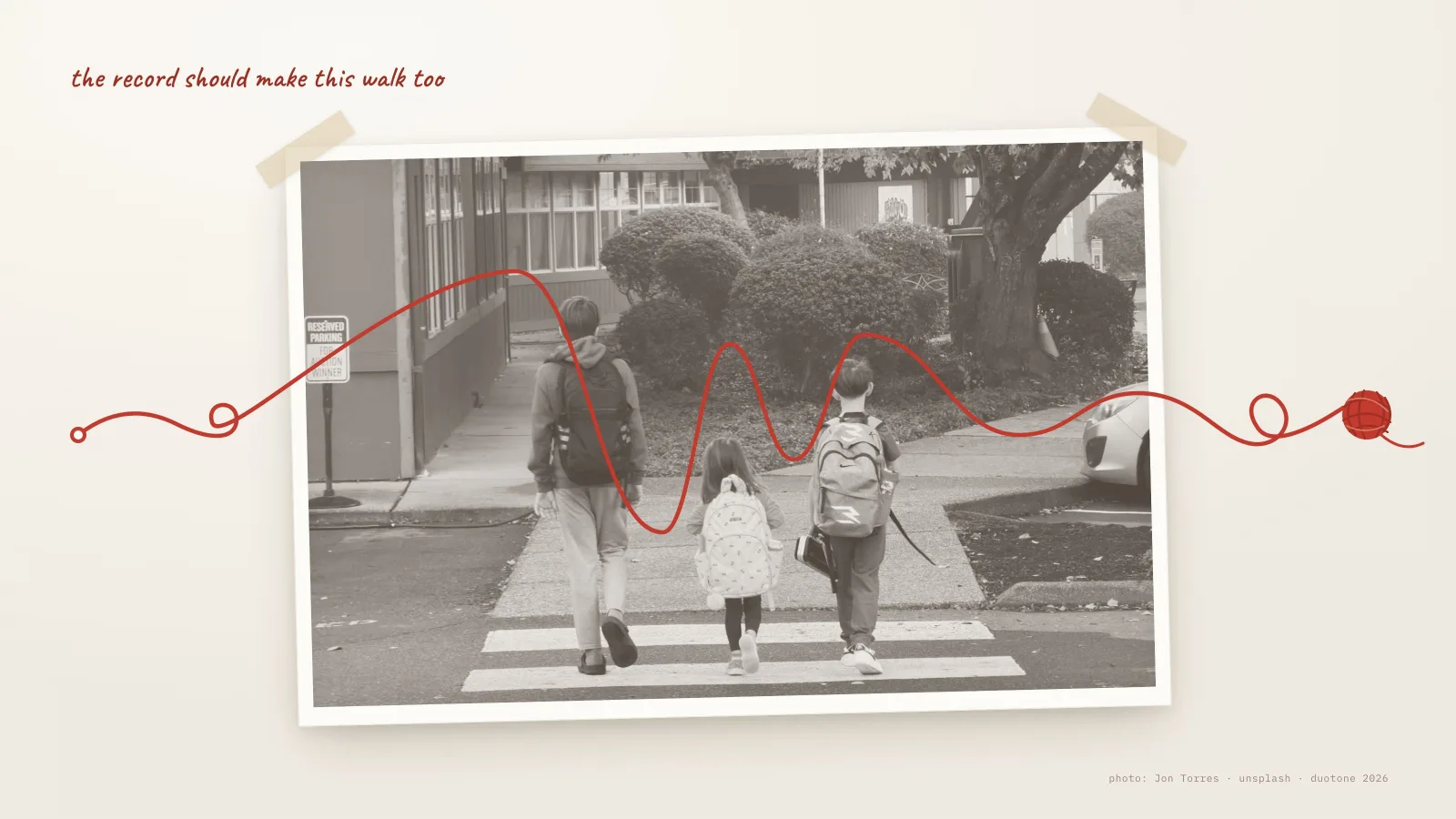
A pupil changes schools, and the record that should follow her does not
Start with the pupil. She is thirteen, in her second Norwegian school, in her second language. Behind her there are session notes, a crisis log, messages between home and school. Each sits in a different system at the school she left. On her first day here, none of it arrives. The counsellor across the table starts from a blank page.
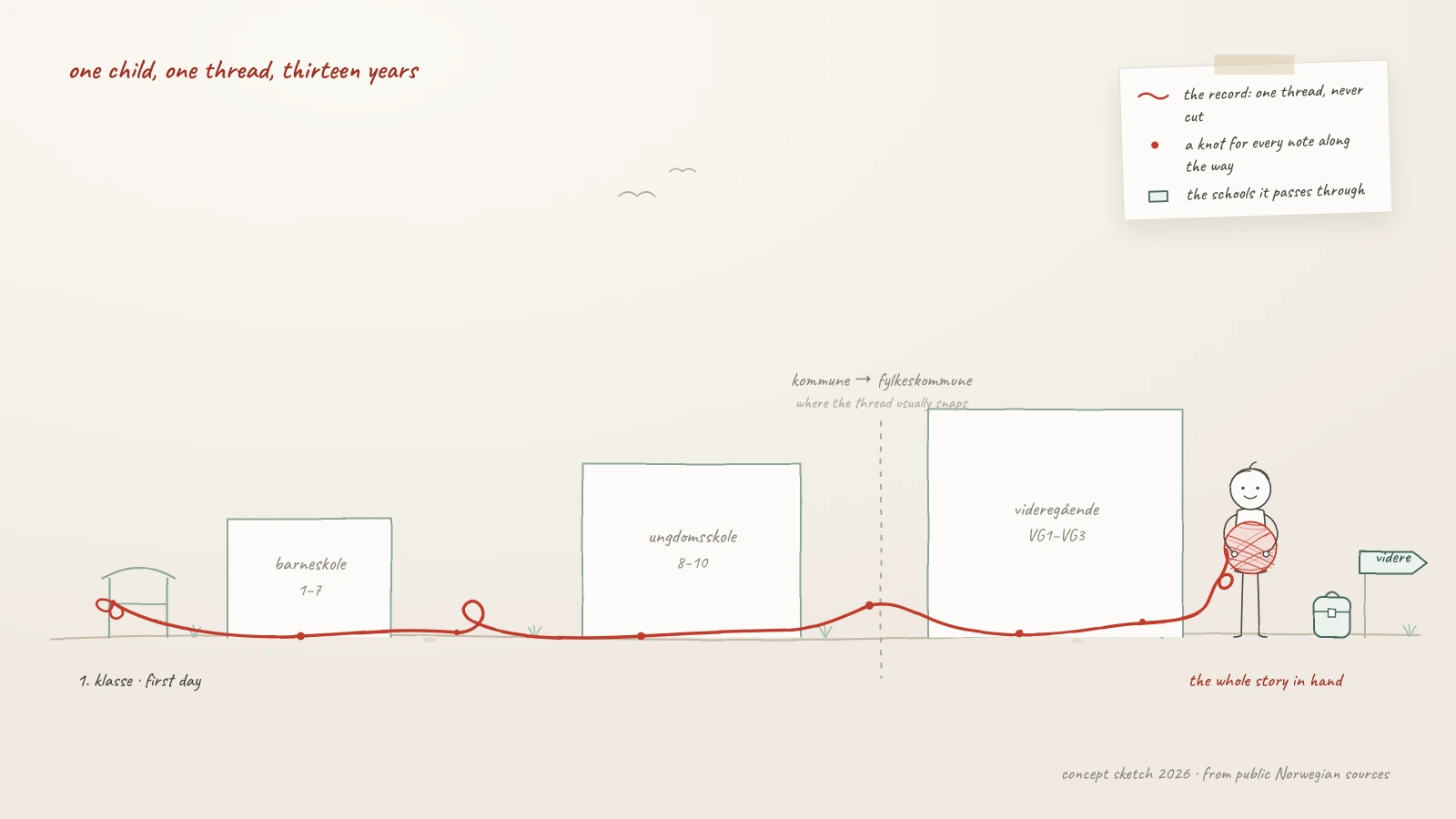
The starting point was ordinary: a market brief for a generic counsellor tool, argued on its feature list. The problem underneath it belonged in Norway. So this concept keeps the problem and sets the product aside. It follows one Norwegian child through thirteen years of school, together with the two adults meant to keep track of them: the rådgiver and the helsesykepleier.
At the legal minimum, half a counsellor post serves 500 pupils
The rådgiver is the person a struggling student is meant to reach. Norway’s minimum sets roughly half a counsellor post per 500 pupils. That half is split between careers guidance and social-pedagogical support. Primary school has no counsellor entitlement at all. Over half of school leaders already call the resource insufficient. Meanwhile about one in five lower-secondary girls reports a high level of psychological distress. The person meant to notice a child is rationed by design.
The record on one child is scattered across systems that do not talk
Session notes sit in one place. The crisis log in another. Parent messages in a third. The school health service keeps its own. In Oslo that can mean Skoleplattform, itslearning, Visma InSchool, Vigilo and Skolemelding, running side by side. Oslo sees this and says so itself: its own digitalisation strategy describes overlapping platforms. Each tool was a sensible answer to its own question. The child is one person, and their record ended up in pieces.
Norway had already built the team, the law, the model, and the software
This is where I expected to propose collaboration. Instead I found that Norway had thought about it harder than almost anywhere I know. A 2022 law made cooperation a legal duty and created a statutory child coordinator. There is a national model, BTI, with a shared relay log and a named person: the stafettholder, who owns the thread for a child the system has already flagged. Vendors sell continuity too. Conexus Elevate markets follow-up that survives staff changes. A country working this hard on the problem deserves a precise contribution, not a reinvention of what it has.
Norway even measured it, and the honest result pointed somewhere new
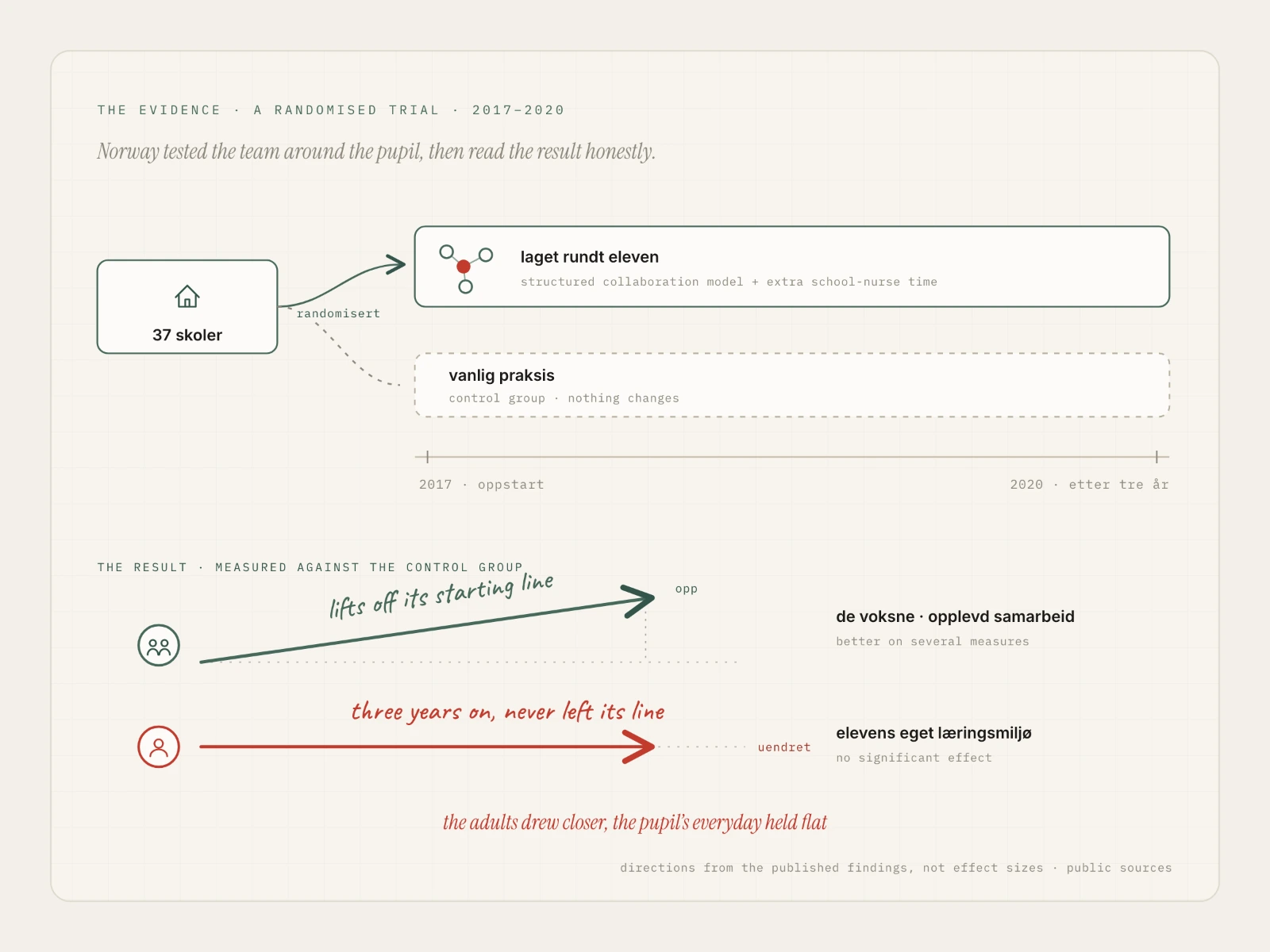
Few countries test their own reforms this rigorously. Between 2017 and 2020 Norway trialled a structured model for the team around the pupil across 37 schools, with extra school-nurse time. It was run as a randomised study. Collaboration between the adults improved on several measures. The effect on pupils’ own learning environment was not significant. That honesty is the gift here. The people around the child were working together better. The thing the child carries had still not caught up.
What is missing is narrower, and more specific, than another tool
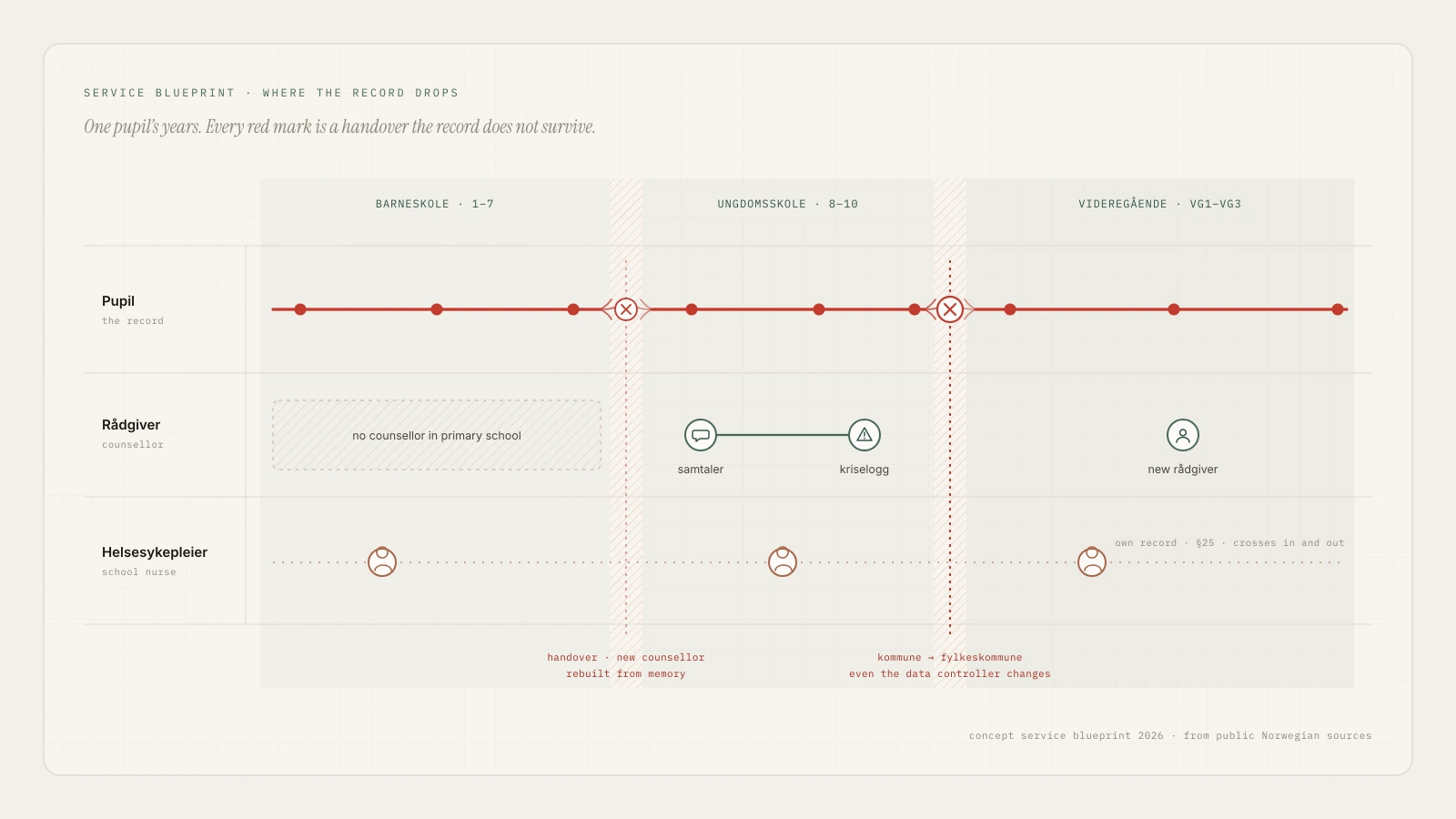
I drew the journey the way a pupil lives it, as a service blueprint. The pupil’s lane on top. The counsellor’s and the school nurse’s underneath. All thirteen years and every change of building. Then I marked every point where the record stops and a person has to rebuild it from memory. The gaps clustered at the handovers.
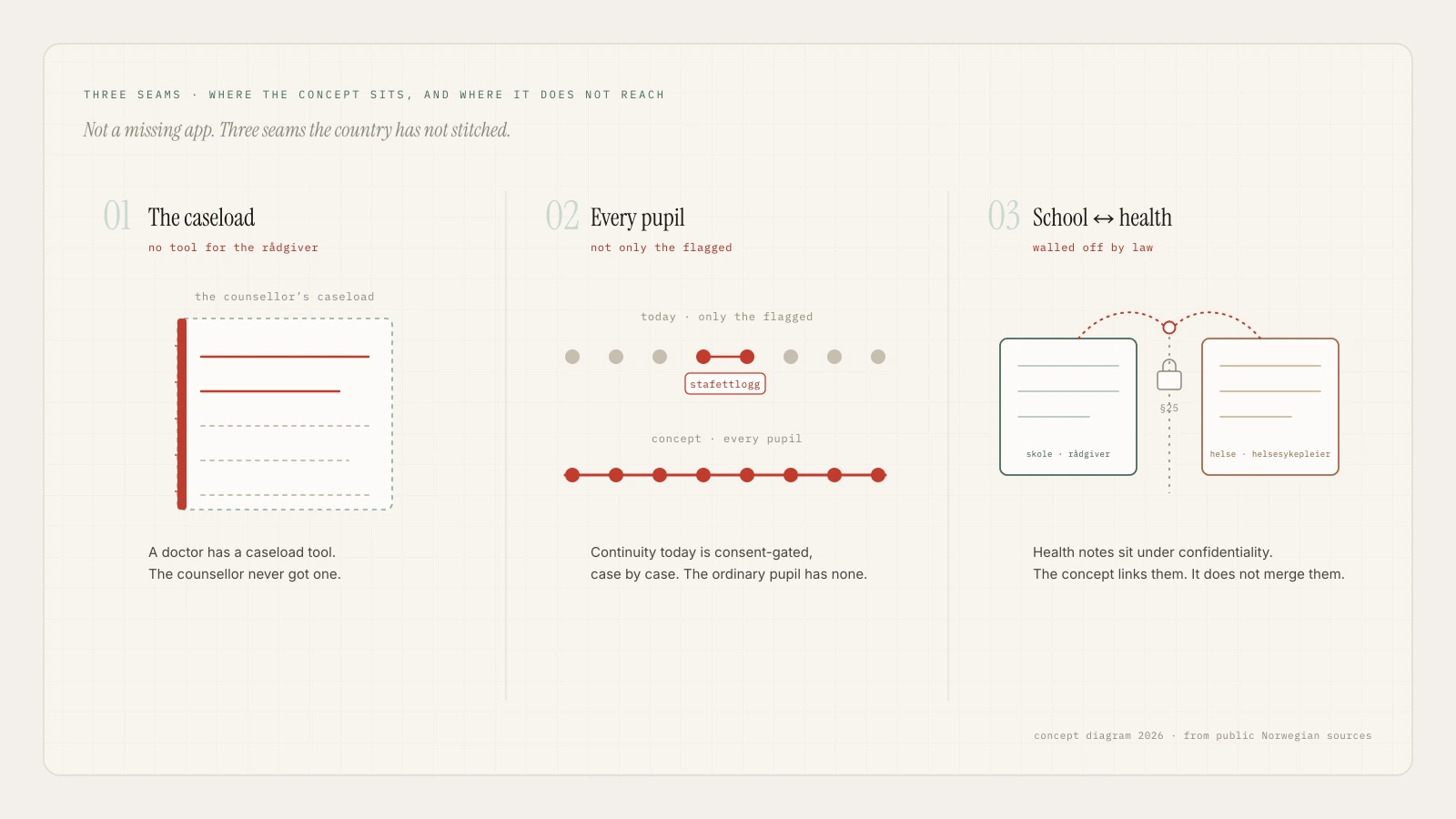
So I stopped hunting for a missing app and looked for the missing seam. Three gaps survive everything Norway has built. There is no tool made for the counsellor’s own caseload, the way one exists for a doctor’s. The continuity that does exist is only for flagged children: case by case, consent-gated, not for the ordinary pupil. Least of all for a newcomer the system has not yet learned to see. And nothing legitimately joins the counsellor and the school nurse. The health record is walled off by law.
One rule held the scope: the record is the product, the app is only a window onto it
Every decision ran through that rule. The value is the continuous record. Any interface is one view of it. So I started where counsellors already work every day. Everything that could wait, waited.
- The counsellor’s own caseload
- Session notes and the crisis log, in one place
- The record that follows the pupil to the next school
- Mental-health screening tools
- Referral routing to outside services
- A parent portal
- Anything that adds a screen without adding to the record
The health record is walled off by law, and the concept designs for the wall, not around it
The school nurse’s notes sit under health-personnel confidentiality. The rule that lets health staff share, helsepersonelloven section 25, explicitly does not reach the school. The duty-to-cooperate reforms all operate inside taushetsplikt. None of them authorise a shared record. So merging the two records is not an option, and I did not design one.
The concept links rather than merges. It treats two hard moments as first-class. At sixteen the young person controls their own health data, and a parent’s access falls away. At the move to upper secondary the data controller itself changes, from municipality to county.
Anything real here needs a data-protection assessment. Probably a conversation with Datatilsynet too. Its 2025 review of fifty municipalities found schools already struggling to govern the data they hold. Designing for that scrutiny is part of the design.
The thread snaps at the move to upper secondary, where even the owner changes
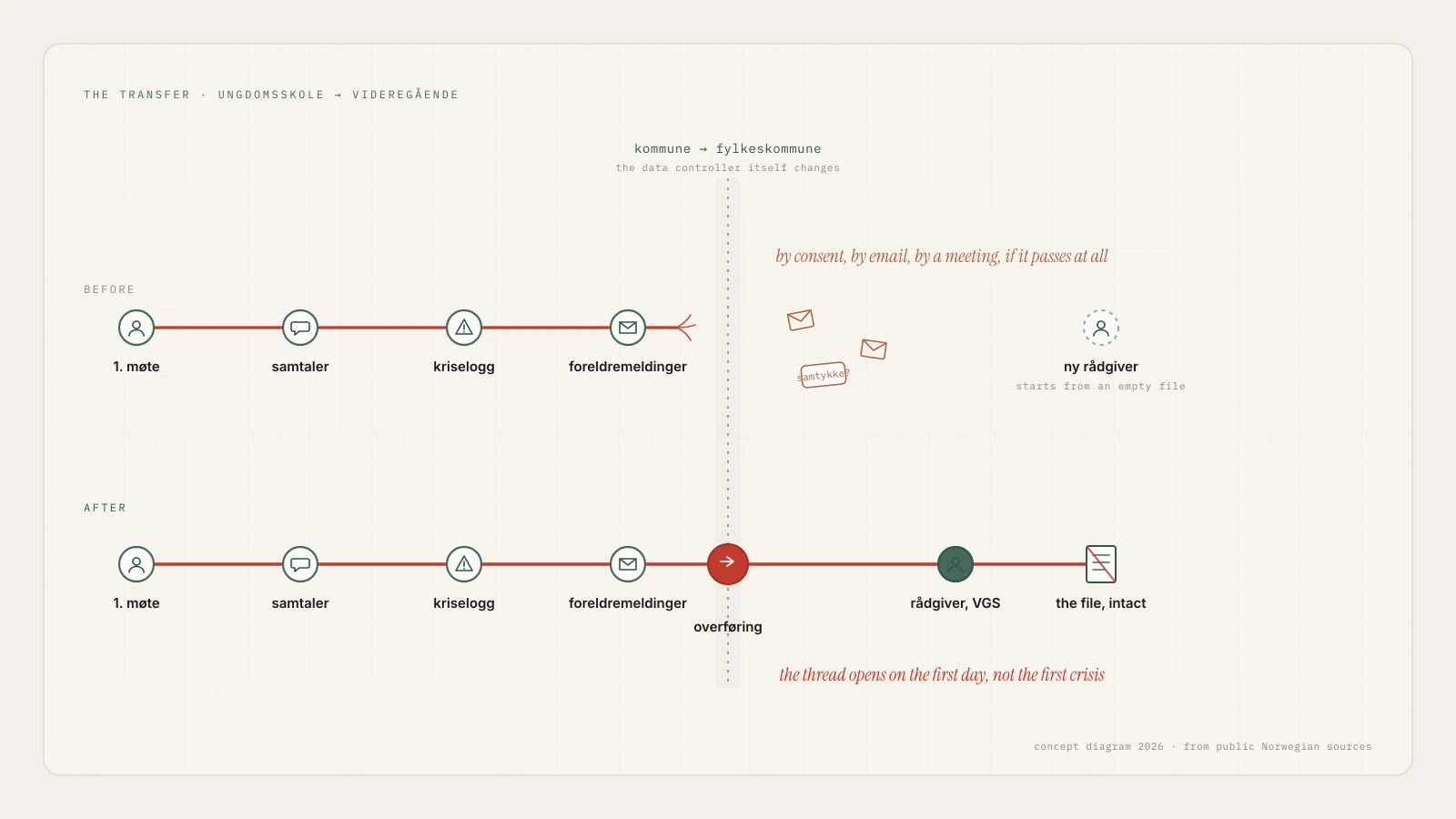
The sharpest break is the step from lower to upper secondary. The municipality runs one, the county runs the other. Today a pupil’s history passes between them only by consent, by email, by an occasional meeting. If it passes at all. The government has a proposal out to widen sharing at a school change. That tells me the gap is real and officially felt.
In the concept, the receiving counsellor opens a transfer and reads the thread from years earlier, on the first day rather than the first crisis. The pupil who moves in from another district, or another country, meets this break with the least stored history. The system loses the most exactly where it can least afford to.
I have no results to show. I have a hypothesis worth testing.
This is a concept. I will not dress it up as an outcome. What I would put in front of Utdanningsetaten is a pilot with a claim attached. It would open with the data-protection assessment, not the interface.
The hypothesis: give counsellors one continuous record and you return counsellor minutes per pupil per week, and you keep those minutes when the pupil changes school.
The earlier trial measured whether the adults felt collaboration had improved. I would measure the thing itself. Time handed back to the counsellor. Context retained across a transfer.
Give counsellors one continuous record and you return counsellor minutes per pupil per week, and you keep those minutes when the pupil changes school.
Every layer of this concept already runs somewhere in Europe
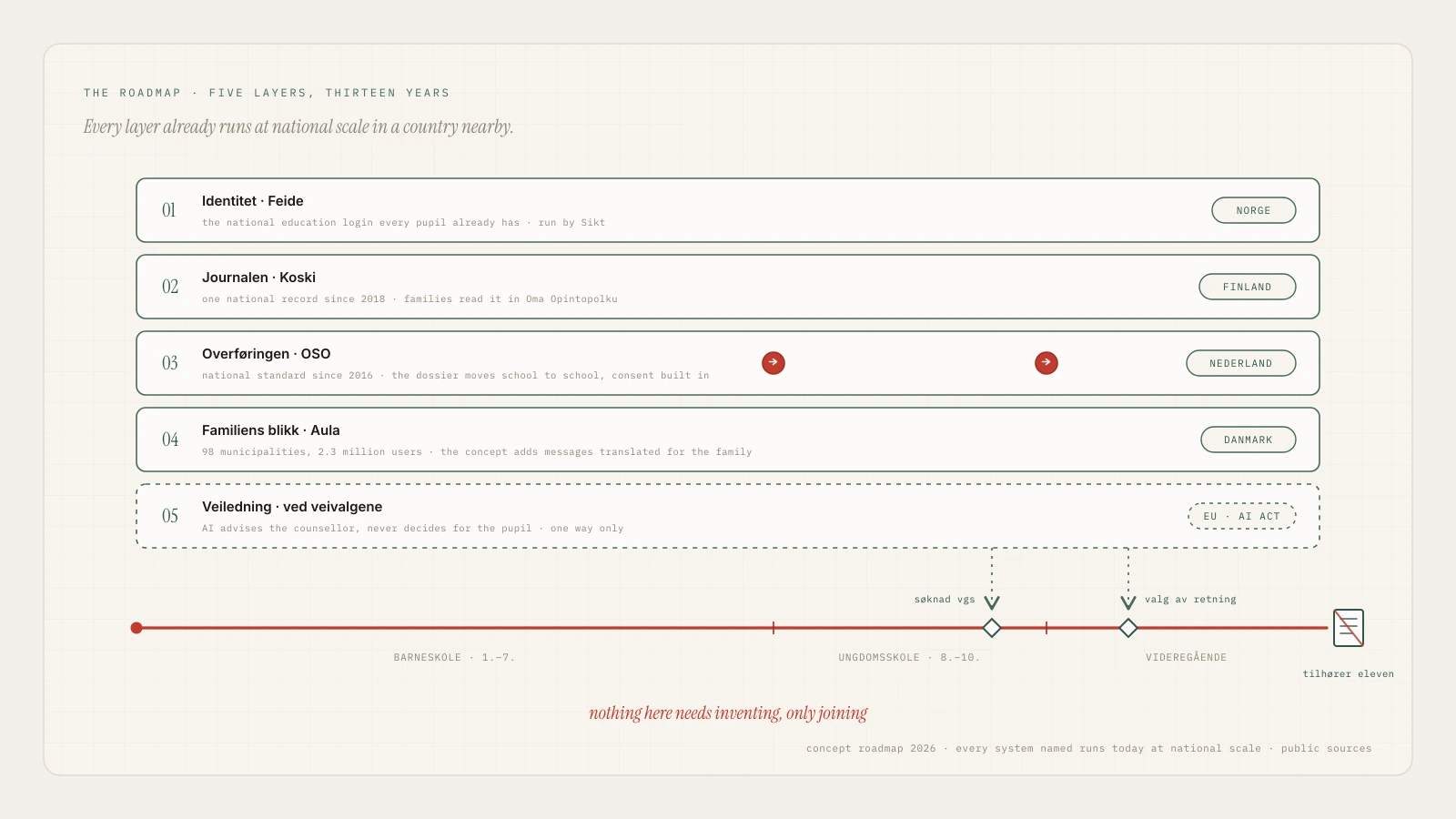
The pilot is deliberately the thinnest slice. One record for the counsellor. One transfer that survives a school change. The fuller idea behind it is a profile that belongs to the pupil, not to the school. One education profile, from the first day to the last. Each new school, and eventually the pupil themselves, can pick it up whole. That is not science fiction. Every layer of it already runs, at national scale, in a country nearby.
- Identity: Norway has it. Every pupil already has a Feide login, the national education identity run by Sikt. Nothing to invent here.
- The record: Finland runs it. Since 2018 the Koski registry has held every pupil’s studies in one national record. Families read it through Oma Opintopolku.
- The transfer: the Netherlands solved it. OSO has been the national standard since 2016. When a pupil changes school, the dossier moves digitally, school to school, with consent built in.
- The family view: Denmark shows the scale. Aula connects schools and homes across all 98 municipalities, 2.3 million users. The concept adds the piece Aula lacks: messages translated into the language the family actually reads.
The last layer is guidance. At the decision points, choosing a study line or applying to videregående, the same profile could sit in front of a careers counsellor. AI would prepare the picture before the conversation. Counsellor time will not stretch otherwise. The EU AI Act rightly treats education AI as high-risk. So this layer works one way only: AI advises the counsellor, and never decides for the pupil.
A profile like this can label a child as easily as it can help one. So the roadmap keeps a right to a fresh start. The minimum crosses by default. Sensitive entries move only by consent. The ownership rules from the confidentiality section hold at every layer.
The pieces existed. The design work was the thread between them.
This project was a systems exercise from start to finish. Take a complicated public service apart on paper. Map where the information about one child lives, and where it dies. Find which existing pieces, a login, a registry, a transfer standard, a family app, could carry it further. That is the work I am drawn to: complex systems, information that has to survive organisational borders, and the digitalisation and AI layer now settling over public services. I treat this case as an opening for that conversation, not as a finished answer.
What I take from it
- Map the whole system before touching any part. Every finding here, the seams, the snapped transfer, came off one sheet with all thirteen years on it.
- The biggest gap was an assumption: that someone holds the whole story. Every tool in the landscape works. None of them owns the thread.
- The strongest idea is the least buildable. Continuity here is a governance problem before it is an interface.
- A shared record can harm as well as help. Fieldwork would show where it protects a child, and where it could quietly expose one.
The child should not have to be the system’s memory.